2025
AR Subtitles
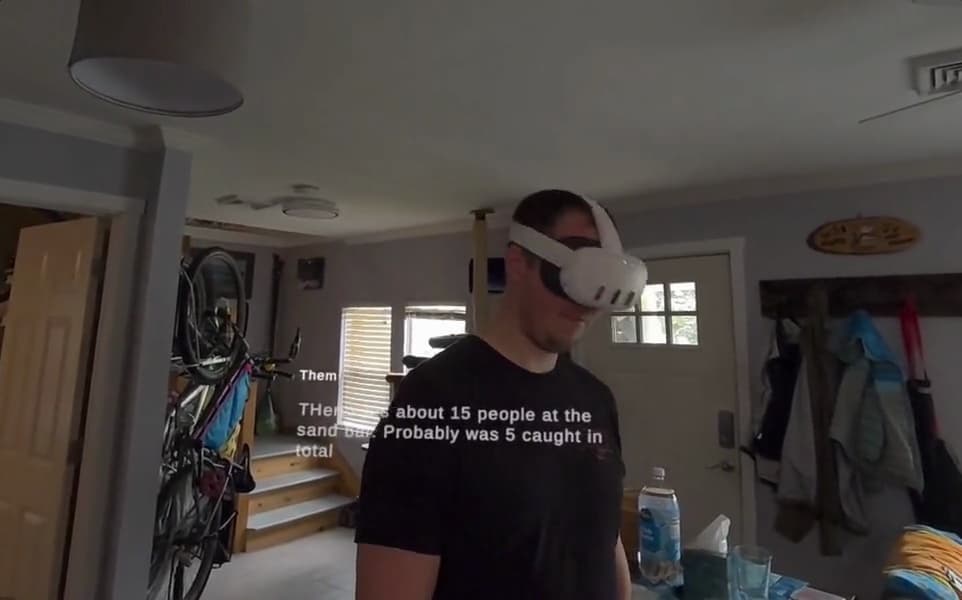
Real-time captions anchored to whoever is speaking, on-device, in AR. A weekly project that became a quiet argument for accessibility-first XR.
Why this exists
I have a friend, Geoff, who is Deaf. In group conversations he uses transcription apps, but the apps don't tell you who said which thing. That gap turns Emily and me into translators-by-proxy: we end up summarizing sentences he could have read directly, just so he knows whose thought it was.
Lightwave is the subtitle app I wanted Geoff to actually use. So Sid and I built it, together, from the ground up, over two weekly project sprints.
What we built
Real-time captions in AR, anchored to whoever is speaking. Voice → text → floating caption pinned to the face of the person who said it. On-device when possible. Works for two people, three people, a noisy group around a table. It's the speaker-attribution part that turns "transcript" into "conversation."
The angle on XR
A lot of XR right now points the wrong direction, toward isolating, hyper-personalized experiences. Lightwave is an argument for the opposite. The most valuable thing co-located XR can do is make people in the same room more available to each other, not less. When a hearing person can look at Geoff and talk to him directly, without a hearing intermediary in the loop, that's ownership of the conversation.
Role and stack
Designer + engineer. Two-person team. Windsurf, Unity, Figma. Built across two weekly-project sprints (Week 2 and Week 3 of my 2025 weekly project run).
Where it's going
Lightwave keeps growing. Each iteration tightens the latency, the attribution, or the visual treatment. Captions need to be readable without competing with the person's face for attention. The design problem is interesting because the constraints are unforgiving: this has to work in a real conversation, in real time, or it doesn't work at all.